

Introduction
Enterprise cloud adoption is no longer a question of if, but how. Yet in large organizations, cloud initiatives frequently slow down, fragment, or quietly fail — even after successful early migrations.
In practice, the problem is rarely AWS itself. The real issue is that cloud environments are often deployed without a coherent enterprise architecture that connects cloud, network, security, and operations as a single system.
In large-scale environments, cloud platforms cannot operate in isolation. They must be anchored on proven network and security foundations from the very beginning.
The Reality of Cloud Adoption at Enterprise Scale
In real-world enterprise environments, we consistently see the same conditions:
- Multiple data centers operating in parallel
- Distributed branch, campus, and remote access networks
- Legacy applications running alongside modern workloads
- Regulatory, security, and audit constraints that cannot be bypassed
When cloud adoption is treated as a standalone technology initiative, several patterns emerge very quickly:
- Cloud accounts multiply without governance
- Network connectivity becomes inconsistent and difficult to troubleshoot
- Security controls diverge between environments
- Costs increase faster than expected, with limited visibility
A Common Mistake: Treating Cloud as a Separate Layer
A mistake we frequently encounter is designing cloud environments independently from existing enterprise architecture. Cloud teams move fast, but:
- Network topology is added later
- Identity and access models are bolted on
- Security logging and monitoring are fragmented
- Operational teams struggle to support the environment
At scale, this approach does not hold. The result is an environment that technically runs — but is operationally fragile.
The Architectural Principle That Changes Everything
Successful enterprise hybrid cloud foundations follow a simple but non-negotiable principle:
Infrastructure, connectivity, and security must be designed as one consolidated architecture.
Rather than deploying AWS environments in isolation, the cloud foundation must extend and align with existing enterprise network and security frameworks. This alignment is what enables scale, resilience, and long-term operability.
What a Real Hybrid Cloud Foundation Includes
In practice, a robust enterprise hybrid cloud foundation consists of:
1. A Governed AWS Landing Zone
- Multi-account architecture aligned with organizational structure
- Centralized identity and access management
- Baseline security controls applied consistently
- Centralized logging and monitoring from day one
2. Integrated Hybrid Network Connectivity
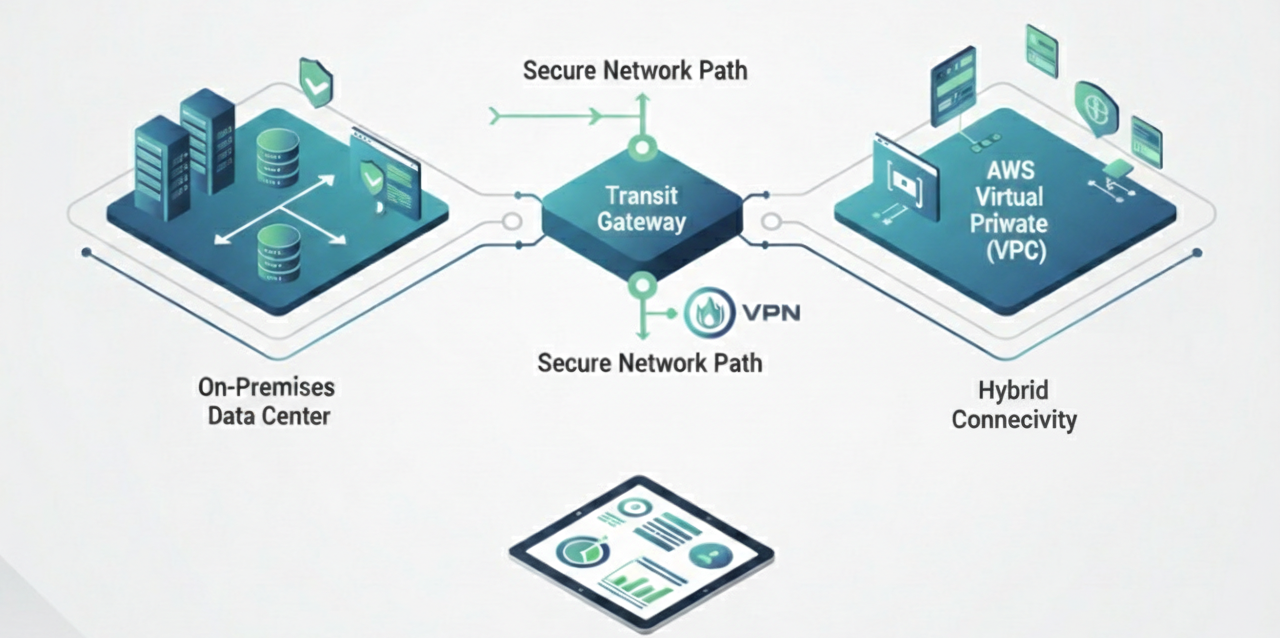
- Secure, resilient connectivity between data centers and AWS
- Predictable routing and traffic control
- Network segmentation aligned with security policies
3. Built-In Governance and Cost Control
- Clear account and workload boundaries
- Financial governance embedded into the architecture
- Visibility across usage, performance, and security events
Why This Architecture Works in Practice
When cloud, network, and security are treated as a single architectural system, enterprises achieve:
- Secure and governed cloud adoption without slowing teams down
- Consistent operations across on-prem and cloud environments
- Faster onboarding of new workloads with reduced risk
- Predictable cost management aligned with business priorities
Just as importantly, the environment remains ready for advanced workloads — analytics, automation, and AI — without re-architecting from scratch.
A Final Perspective
Enterprise cloud transformation is not about moving workloads to AWS. It is about designing an architectural foundation that the organization can operate, secure, and evolve over time.
In our experience, cloud initiatives succeed when they are treated as enterprise architecture programs, not migration projects.