


AWS Istanbul Local Zone Goes Live: What It Means for Cloud, Latency and Data Residency in Türkiye
Amazon Web Services has officially flipped the switch on its new Local Zone in Istanbul, planting world-class cloud infrastructure on Turkish soil and rewriting the latency, compliance, and performance calculus for every organization operating in the country.
What Are AWS Local Zones
AWS has announced the general availability of a new AWS Local Zone in Istanbul, Türkiye, bringing AWS infrastructure closer to end users while enabling organizations to meet data residency requirements by storing and backing up data locally.
AWS Local Zones are AWS infrastructure deployments that extend core services such as compute, storage, networking, and other select services closer to metropolitan areas worldwide. The new zone, identified as eu-central-1-ist-1a and enabled from the Zones tab in the Amazon EC2 console settings or by using the ModifyAvailabilityZoneGroup API, operates as a child of the Frankfurt parent Region.
Each Local Zone is a child of a particular parent region and is managed by the control plane in that region, in this case Frankfurt. Local Zones were first launched in 2019 in the US, and they now extend that proven architectural pattern to one of Europe’s largest and most strategically important metropolitan economies.
What makes the Istanbul launch particularly noteworthy is its scope. The Istanbul Local Zone brings Amazon Simple Storage Service (Amazon S3) to help customers store, process, and retrieve objects locally, and Amazon EBS Snapshots for fast, in-country backups and recovery directly to Türkiye.
This marks the first time Amazon S3 and Amazon EBS Snapshots are available in AWS Local Zones in EMEA, opening up new possibilities for customers in Türkiye.
In other words, Istanbul is not merely another dot on the AWS map. It is the most capable Local Zone AWS has ever deployed across Europe, the Middle East, and Africa.
A Decade of Quiet Build-Up
The Istanbul Local Zone is the culmination of a methodical, multi-year infrastructure investment that AWS has been making in Türkiye.
Since opening its first office in Türkiye in 2015, AWS has been steadily expanding infrastructure. In January 2024, AWS launched AWS Outposts in Türkiye, helping customers extend AWS infrastructure and services to on-premises or edge locations for a consistent hybrid experience.
In February 2024, AWS launched an Amazon CloudFront edge location in Istanbul, delivering up to 30% improvement in latency and performance for content delivery to Turkish users.
In May 2025, AWS opened an AWS Direct Connect location in Istanbul, helping customers establish private, dedicated network connections between on-premises infrastructure and AWS with dedicated 10 Gbps and 100 Gbps connections with MACsec encryption.
That earlier Direct Connect node, opened within the Equinix IL4 data center near Istanbul, became the first AWS Direct Connect location within Türkiye, laying the high-bandwidth groundwork that the new Local Zone now exploits.
The result is a layered, interoperable footprint. The Istanbul Local Zone integrates with existing infrastructure including AWS Outposts deployments, AWS Direct Connect connections, and Amazon CloudFront distributions, and maintains connectivity to AWS services in the Region for flexible hybrid and multi-Region architectures.
For Türkiye, this means a fully composable AWS stack now lives inside the country.
Services Available on Day One
The AWS Local Zone in Istanbul supports Amazon Elastic Compute Cloud (Amazon EC2) with C7i, M7i, and R7i instances, Amazon S3 with the One Zone-Infrequent Access storage class, Amazon EBS with Local Snapshots and volume types gp3, gp2, io1, sc1, and st1, Amazon Elastic Container Service (Amazon ECS), Amazon Elastic Kubernetes Service (Amazon EKS), Amazon Virtual Private Cloud (Amazon VPC), AWS Direct Connect, and Application Load Balancer.
Broken down by workload pattern, this means:
- Compute: Customers can launch Amazon EC2 instances for compute-intensive, general-purpose, memory-optimized, and distributed AI/ML inference workloads with support for On-Demand Instances, Spot Instances, and Savings Plans.
- Storage: Organizations can store, process, and retrieve data locally with Amazon EBS and Amazon S3 using the One Zone-Infrequent Access storage class, keeping application data, media assets, backups, and analytics datasets within the country to meet regulatory requirements. Backups can be created and managed locally with Amazon EBS Snapshots, providing faster recovery times and a business continuity strategy that stays in-country.
- Networking: Customers can build isolated network environments with Amazon Virtual Private Cloud (Amazon VPC) and distribute traffic across instances with Amazon Elastic Load Balancing (Amazon ELB).
- Containers and Orchestration: Native support for Amazon ECS and Amazon EKS means the modern, container-native applications already standardized by Turkish fintechs, retailers, and SaaS firms can run inside the Local Zone without architectural compromise.
Lower Latency
AWS Local Zones help customers achieve single-digit millisecond latency for end-user workloads, meet data residency requirements, support AI/ML inference workloads, and accelerate migration and modernization of legacy applications to the cloud, all while maintaining consistent AWS APIs, tools, and services as AWS Regions.
Real-time fintech engines, live commerce checkouts, telehealth video sessions, multiplayer gaming, and AI inference pipelines all operate in a regime where every millisecond of network latency compounds into measurable user experience and revenue impact.
AWS Local Zones place cloud infrastructure closer to major metropolitan areas, enabling single-digit millisecond latency for end users. This capability is particularly critical for financial institutions conducting high-frequency trading and healthcare providers processing sensitive patient data.
The AWS Local Zone allows organizations to store and process data within the country’s borders, a decisive advantage for public institutions and financial organizations operating under strict personal data protection regulations.
Data Residency in Türkiye
KVKK obligations, sector-specific banking and insurance directives, and public sector procurement criteria have all pushed organizations toward awkward hybrid arrangements: a little bit of cloud, a lot of on-premises, and a thick layer of legal review.
The Istanbul Local Zone solves much of that complexity. Data can now be stored and backed up within Turkish borders to help meet data residency requirements, and latency-sensitive workloads can run in the Istanbul Local Zone while connecting seamlessly to the AWS Region, giving the flexibility to architect hybrid applications without managing private data center infrastructure.
Crucially, this capability spans regulated verticals. The new zone supports compliance needs across financial services, government, telecoms, and healthcare. For Turkish banks, brokerages, insurers, hospitals, and government bodies, the practical translation is that compliance-grade architectures no longer require a dedicated data center footprint. The Local Zone delivers Region-grade rigor with in-country sovereignty over data placement.
And, with its strategic geographic location and rapidly expanding digital economy, Türkiye is increasingly positioning itself as a bridge between Europe, the Middle East and Asia, supported by tangible infrastructure investments.
How to Get Started
Operationally, onboarding is intentionally lightweight. To get started with the Istanbul Local Zone, customers opt in to the Istanbul Local Zone on AWS Global View and create a Local Zone subnet on the Amazon VPC console. That’s it.
Customers can then launch EC2 instances and create EBS volumes in the Amazon EC2 console, store objects in Amazon S3 in the Amazon S3 console, and use the other services in this Local Zone using the same APIs and tools. For most organizations already using AWS in Frankfurt or Dublin, repointing latency-sensitive workloads to Istanbul becomes a subnet-level architectural decision, instead of a re-platforming exercise.
That is precisely the design intent behind Local Zones, and it is what makes the Istanbul launch immediately consumable by Turkish enterprises of every size.
What This Means If You Are Building in Türkiye
The arrival of a fully featured AWS Local Zone in Istanbul changes three calculations at once.
- The first is latency economics; Workloads that were borderline on a Frankfurt round trip, real-time bidding engines, AI inference for customer support, live commerce, multiplayer experiences, become unambiguously viable when served from inside the country.
- The second is regulatory posture; KVKK-sensitive workloads, public sector pilots, and BDDK-aligned financial systems can now consume hyperscale cloud capabilities without compromising on data localization. That removes the most common objection that has historically slowed cloud adoption inside Türkiye’s most strategic industries.
- The third is architectural ambition; With S3, EBS Snapshots, EC2 7i-generation instances, EKS, ECS, VPC, and Direct Connect all in-country, organizations can now design genuinely modern cloud-native systems, including AI inference layers, without the latency tax or the residency caveat.
The Istanbul Local Zone gives enterprises in Türkiye a new foundation for building cloud architectures that are faster, more local, and better aligned with modern regulatory expectations. For organizations already running workloads on AWS, it creates an opportunity to rethink latency-sensitive applications, backup strategies, AI inference workloads, and hybrid architectures with Istanbul now part of the infrastructure equation.
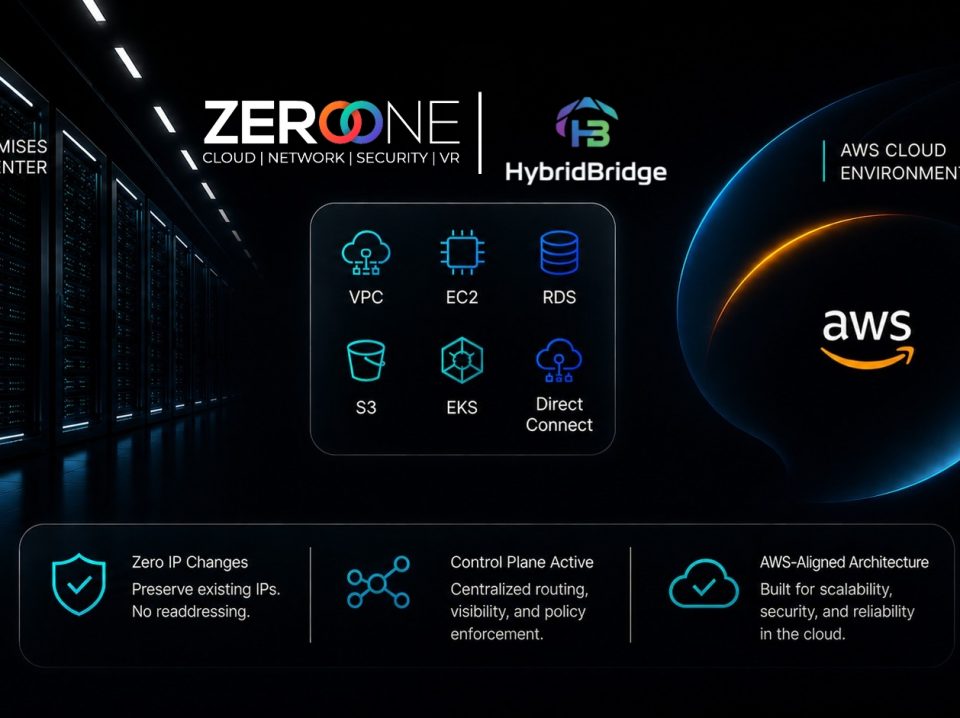
Zero1 Technology supports enterprises across Networking, Cybersecurity, Managed Ops, Cloud Strategy, Migration & Hybrid Infrastructure Modernization. Whether the priority is improving application performance, strengthening data residency posture, connecting on-premises systems to AWS, or planning a phased migration with minimal disruption, Zero1 can help teams move from evaluation to execution. For businesses that need to preserve IP continuity during migration and where application stability is critical, HybridBridge can help enterprises move to AWS without forcing unnecessary network or application redesign.
To explore how the AWS Local Zone in Istanbul fits into your cloud roadmap, compliance strategy, disaster recovery model, or AI infrastructure plans, and for more information on Zero1’s broader suite of Cloud, Network , Security, Managed Ops and VR solutions, view our service offerings, or Connect with us to schedule a demo or discuss your use case with our team.